
High Performance AI and High Performing Humans – Are There Comparisons?
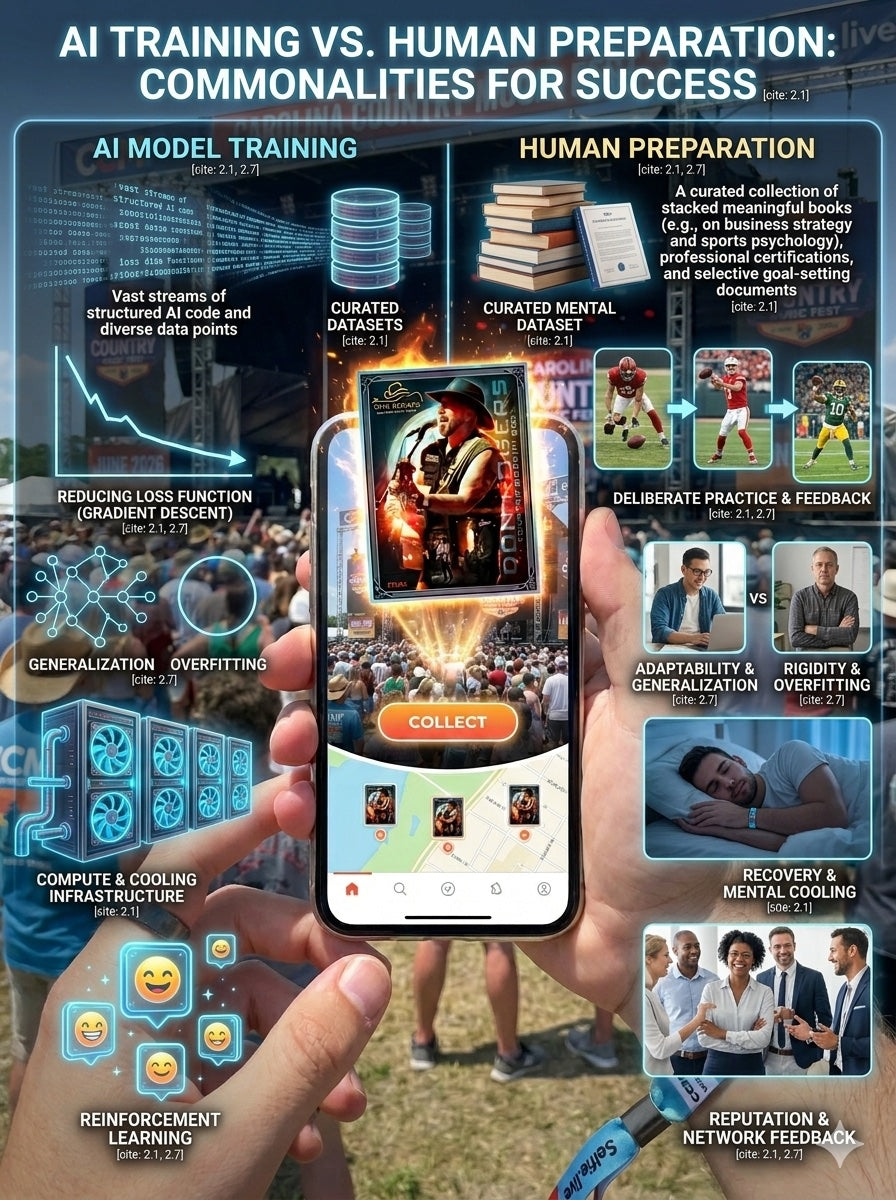
It’s a fascinating parallel. At their core, both high-performing humans and state-of-the-art AI models are complex systems designed to recognize patterns, predict outcomes, and minimize "error" in their respective environments.
The comparison boils down to how inputs (training) are converted into expertise (inference).
1. Data Quality and "Curation"
Just as a Large Language Model (LLM) is only as good as its training data, a human’s success is heavily dictated by their "data" sources—the books they read, the mentors they follow, and the environments they inhabit.
- The AI Parallel: If you train a model on "toxic" or low-quality data, you get Hallucinations and bias.
- The Human Parallel: High performers in sports and business are ruthlessly selective about their information intake. They curate their "mental dataset" to include high-signal, low-noise information.
- The Commonality: Success is an emergent property of quality input. You cannot output excellence if you are consuming mediocrity.
2. The Feedback Loop: Gradient Descent vs. Deliberate Practice
AI models learn through a mathematical process called Gradient Descent, where they calculate how far their guess was from the truth and adjust their "weights" to be more accurate next time.
- In Sports: An elite quarterback doesn't just throw; they analyze the arc and the footwork, adjusting by inches in the next rep. This is the human version of reducing the "loss function."
- In Business: A CEO uses market feedback (revenue, churn, NPS) to iterate on a product.
- The Commonality: Both systems require a tight feedback loop. High performers don't ignore failure; they treat it as a data point for weight adjustment.
3. Generalization vs. Overfitting
A common failure in AI is Overfitting, where a model becomes so good at its specific training data that it fails to handle a new, real-world scenario.
- The AI Parallel: A model that memorizes the textbook but can’t answer a creative question.
- The Human Parallel: The "specialist" who is so rigid in their ways that they cannot adapt when the market shifts or the opponent changes their defense.
- The Commonality: Long-term success requires Generalization. You need enough "parameters" (skills) to handle variety, but enough "regularization" (principles) to keep from getting lost in the weeds.
4. Computational Intensity and "Burnout"
Training a massive model requires incredible amounts of energy and cooling. Similarly, high performance in humans is biologically "expensive."
- The AI Parallel: High-end GPUs require massive cooling systems to prevent thermal throttling.
- The Human Parallel: Athletes and executives require sleep, nutrition, and mental "cooling" to prevent burnout (their version of thermal throttling).
- The Commonality: You cannot sustain peak "compute" without recovery infrastructure. The more intense the output, the more robust the cooling/recovery system must be.
Key Commonalities at a Glance
|
Feature |
Large Language Model |
High-Performing Human |
|
Objective |
Minimize Loss Function |
Achieve Goals / Win |
|
Method |
Backpropagation |
Deliberate Practice / Reflection |
|
Foundation |
Massive Datasets |
Experience & Education |
|
Failure Mode |
Hallucination / Overfitting |
Arrogance / Rigidity |
|
Maintenance |
Energy & Cooling |
Nutrition & Sleep |
The "Reinforcement" Stage
One of the most powerful parts of AI training is RLHF (Reinforcement Learning from Human Feedback), where the model is fine-tuned based on what humans find "helpful."
In your life, this is your reputation and network. You fine-tune your "success model" based on the feedback of your peers, customers, and coaches. The more you align your "outputs" with what the world finds valuable, the more "successful" you become.
Read more

Gamifying Beauty Pageants: Beauty pageants are more than just competitions; they are global cultural phenomena. From Manila to Medellín, millions tune in to watch national representatives vie for t...

The high-gloss, "pop-out" digital assets we see in today’s Web3 ecosystems didn't start with a blockchain; they started in a cereal box. Long before the NFT craze of 2022 turned digital ownership i...